village-center-Saint-Paul-Community

Headline news
Wednesday 18 th September 2024

Dolores Puértolas shares this good news from Sabana Yegua.


This summer that has just ended has been even more vibrant than the previous ones in Sabana Yegua. It is a time of visits and very fruitful encounters for both the local community and for the people who visit us from different countries. These are the different groups that have visited us from abroad in recent months.

Seminarians from the Archdiocese of Milwaukee. In what has already been configured as a mission experience and a linguistic immersion, six young men in preparation for the priesthood spent two months with us. The first month they took a Spanish course in Santiago de los Caballeros, in the north of the country, through the Catholic College Pontificia Universidad Madre y Maestra. The other month they collaborated in the different activities of the La Sagrada Familia Parish. The cultural and religious experience, the experience of diversity and the universality of the Church is what the seminarians value most in their time in these lands.

Sonríe y Crece Association. This is a group of volunteers from Spain who for 15 years have been visiting the Dominican Republic in the summer. Once here, they carry out a school reinforcement programme in the mornings and games for children in the afternoons, through which they transmit values ​​and educate the little ones. They have also given talks on how to build houses safely to cope with the Caribbean hurricane season and activities to promote health and physiotherapy. Every year, young Spaniards from different professions dedicate themselves for two months to sharing their knowledge and friendship with the children and young people of Sabana Yegua. What they highlight most is the wonderful experience of having dinner with the children's different families, the excursions to climb the hill near the town with the little ones, as well as being able to get to know the warm culture of the country.

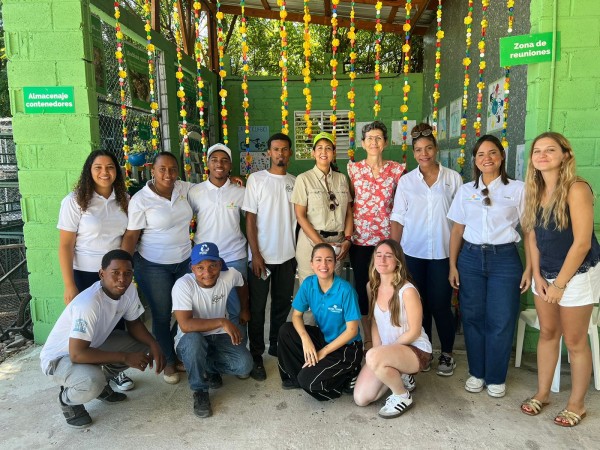
ESADE SUD interns. We have been collaborating with this Spanish Business School for four years: for three months, two interns who are about to finish their studies work at the Eco-hotel and retreat house Altos de la Caobita of the Community of Saint Paul in Barrera, located within the parish territory of La Sagrada Familia. This year they helped to improve the internal organization, create new products and promote the project. This year, we also started collaborating with the plastic recycling program “Reciclaplus” and created ecological packages to learn about the recycling initiative.

Professors from the Polytechnic University of Catalonia. For the first time, two professors from the UPC School of Agronomy visited us to collaborate with the eco-hotel and develop a plan for varied crops that can be replicated in the communities, optimizing the use of water, a resource that is so scarce here in the South of the Dominican Republic. These were two intense weeks of a lot of learning and now it is time to get down to work with the plan we have drawn up.

We are grateful for these many contributions, which leave us with a deep feeling of friendship and are proof of the solidarity that so many people are eager to offer and share.


Thursday 29 th August 2024


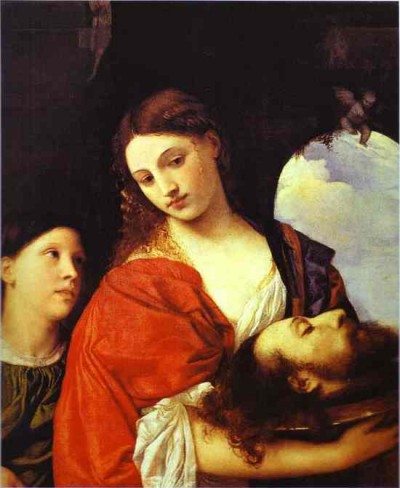
Today, August 29, the Church remembers the martyrdom of John the Baptist. I have always thought that the story that Mark tells us in the sixth chapter of his Gospel (Mk 6:17-29) functions as a parenthesis within the general narrative to describe the worst aspects of the world in which Jesus wants to announce his good news. In the scene, full of details, there is betrayal, hatred, violence, manipulation, vanity, cowardice. In other words, everything that stands against the hopeful message of the prophet of Nazareth. The terrible death of the Baptist is like a warning: Beware! The evangelist tells us: this is the landscape facing Jesus... and all of us.
 
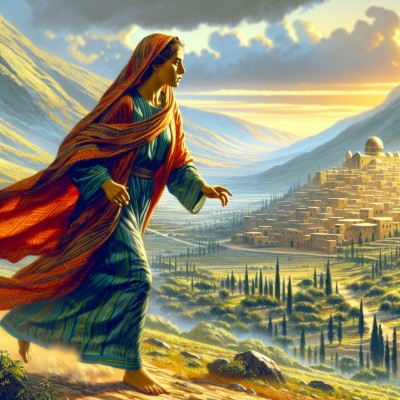
The most disturbing character in the story is the young dancer—the girl who, without intending to, finds herself at the center of the action. Mark does not name her (he simply presents her as "the daughter of Herodias"). It is Flavius ​​Josephus, in his Antiquities of the Jews, who tells us that the little girl was called Salome (book XVIII, chapter 5,4).
 
Salome is disturbing because she is innocent and yet becomes the necessary instrument to bring about John's death.
 
Herodias, her mother, appears as someone without scruples, full of hatred and evil intentions, who from the beginning wants to eliminate the Baptist. She is, so to speak, "the villain," a character without nuances, almost a caricature. Her daughter, on the other hand, is a young woman without bad intentions who simply obeys what she is told: to dance for the king. And, once she has danced and Herod, dazzled, has promised her that he will give her whatever she asks for ("even if it is half my kingdom," he swears foolishly), she runs to ask Herodias what she should ask for. When her mother tells her to ask for John's head, the girl, without thinking twice, instead of refusing to participate in the tragedy, returns to the king and asks for the prophet's life.
 
None of us are Herodias, but we can all become Salome. That is the reason for the uneasiness that this young character should cause us. We are not perverse like the mother, but we can all, at times, be naive and frivolous like the daughter. Then we could allow ourselves to be manipulated by dark forces that overwhelm us and we could end up being instruments that favor the cause of evil.
 
Salome is a warning: she cautions us against the danger of falling into superficiality, of sinning by being naive.
 
The point, of course, is not that we should become distrustful of everyone in an unhealthy manner. The point is that we should never fall into naiveté. When we ignore the power of the hatred that dwells in some people, then it is possible that this hatred may end up taking advantage of our blindness.
 
We must avoid being like Herodias, but that is not the difficult part. What is truly hard is never to be like Salome either.


Wednesday 17 th July 2024
 

Recently the Cardinal of Bogotá, Archbishop Luis José Rueda Aparicio, together with his two auxiliary bishops (Germán Medina and Alejandro Díaz), made a three-day pastoral visit to the Episcopal Deanery of San Pablo, in the southeast of the Colombian capital. La Resurrection Parish, which is run by the Community of Saint Paul, is located in that Episcopal Deanery.
 
During the visit, a meeting of the cardinal with young people from the Deanery was organized, which took place in the La Resurrección parish. After the meeting, Bishop Luis José Rueda and his auxiliary bishops accompanied the young people of the parish on the “Aguapanela Route”: they spent almost three hours walking through the neighborhood, greeting the homeless people they met and giving them a glass of hot “aguapanela” and a chicken sandwich.
 
It was a beautiful experience, and a great opportunity for the Cardinal to learn first-hand the reality of those who live on the streets in this sector of Bogotá, mostly people who consume psychoactive substances. At the end of the Route, archbishop Luis José expressed his satisfaction, pointing out that these activities are essential for the Church to get closer to those who are most vulnerable in our society.


Tuesday 28 th May 2024
 
Denny Jacob and his family after the ordination


On May 18, nine young men were ordained priests in the cathedral of Milwaukee, Wisconsin (USA). Among them was a member of the Community of Saint Paul: Denny Jacob, a native of India, who after a long formation process with our Community (first in the Dominican Republic and later in the USA) that day completed his preparation for the priestly ministry.

His parents and the members of the CSP were able to accompany him in his ordination, praying that God would grant him many years of fruitful pastoral life. We know that for Denny and his ordination companions what now begins is a path full of joys and also, why deny it, difficulties: a path that is both beautiful and demanding, always marked by the desire to serve those most in need. Congratulations to the newly ordained!


Tuesday 14 th May 2024
 
The ancient city of Philippi, today

During the Easter season—which we will conclude this coming Sunday with the great feast of Pentecost—, at Mass we have been reading the book of the Acts of the Apostles. Every year, when we engage in this exercise of reading continuously the second volume of Luke’s story, one is amazed at the depth, the narrative richness, and the wisdom of this account. Today I would simply like to focus on a scene that we find in chapter 16: the conversion of the Philippian jailer.
 
Let us remember the episode: Paul and Silas are in northern Greece, in the city of Philippi, «the main Roman colony in the district of Macedonia» (16:12). There, Paul expels an evil spirit from a slave who, with her talents for fortune-telling, until that moment had brought great profits to her masters. These, «seeing that all hope of earning money was gone» (16:19), accuse Paul and Silas of altering the city’s peace. Consequently, the magistrates order that the two Hebrews be flogged. After receiving many lashes, they are sent to prison. The jailer is asked to keep a close eye on them.
 
At night, an earthquake shakes the foundations of the prison, opening up its doors. The jailer, assuming that the prisoners have used the opportunity to escape, is about to commit suicide when Paul, from his cell, warns him that no one has escaped. The man, stupefied, throws himself at the feet of Paul and Silas and asks them how he can be saved. Then they proclaim the Gospel to him. Immediately afterwards—and this is what we wanted to underline—, the jailer takes them with him, washes their wounds and is baptized along with his family (16:33). Before being baptized, he cleans the wounds of Paul and Silas. These are the same wounds they had when they entered the prison, the result of the beating they received before being entrusted to the jailer. These are the wounds he completely ignored when hours before he hastily locked them up. Those wounds to which he did not give the slightest importance then, now touch him. Even more: now they are an emergency. The priority is to wash the wounds; then he can be baptized.
 
The way the jailer looks at Paul and Silas’ wounds is important. What was invisible before his change of heart—the bruises, the open flesh, the blood—later becomes essential. Perhaps this good man (dedicated to a profession as hard and dehumanizing as that of locking up criminals), draws with his own process an itinerary in which we can all see ourselves reflected. It is also an itinerary that establishes an infallible criterion to evaluate our degree of understanding of the Gospel. Probably, all of us can recognize ourselves in the jailer when we think of those times when other people’s wounds seemed invisible. All of us can think of instances in which God manifested himself to us precisely through wounded people. And perhaps we can remember with joy those moments when the wounds of others moved us, and we wanted to do something to heal them.
 
In the jailer’s journey we discover the fundamental criterion that distinguishes a person who lives the Gospel from a person who does not: the second is indifferent to the wounds of others. The first, on the other hand, does everything he can to alleviate the pain of those who suffer. The converted jailer, eager to follow Jesus, does not fall on his knees, overcome with piety, and praise God with half-closed eyes, nor does he run to the temple to offer a sacrifice, nor does he lose himself in complicated theological sermons: he rolls up his sleeves and cleans the wounds of his brothers.
 
The extent to which the wounds of others move us or not will always indicate, with surprising precision, the quality of our faith.


RSS news feed

Blog archives


Contact

1505 Howard Street
Racine, WI 53404, USA
racine@comsp.org
Tel.: +1-262-634-2666

Mexico City, MEXICO
mexico@comsp.org
Tel.: +52-555-335-0602

Azua, DOMINICAN REPUBLIC
azua@comsp.org
Tel. 1: +1-809-521-2902
Tel. 2: +1-809-521-1019

Cochabamba, BOLIVIA
cochabamba@comsp.org
Tel.: +591-4-4352253

Bogota, COLOMBIA
bogota@comsp.org
Tel.: +57-1-6349172

Meki, ETHIOPIA
meki@comsp.org
Tel.: +251-932508188